How to vet a roaming band when you can’t see them live: review uncut performance videos, live audio, testimonials, references, repertoire samples, technical documents, and communication quality before booking.
Because every band is different, this process should help you make your own informed decision rather than assuming any platform has verified or certified the performer for you. Below, you’ll find a practical remote evaluation checklist to assess live performance quality, guest interaction, reliability, logistics, and event fit.
Why remote vetting matters and what to expect
Choosing music for an event where performers move through a crowd adds variables that aren’t obvious from photos or a short clip. Roaming bands must manage proximity, dynamic acoustics, guest interaction, and seamless transitions across spaces. When you learn how to vet a roaming band you shift the decision from guesswork to measured evaluation: you identify predictable indicators of stagecraft, volume control, arrangement flexibility, and crowd management. That reduces risk for timing, guest experience, and noise-sensitive venues.
Remote vetting is not about finding perfection; it’s about determining acceptable margins. For example, a band might have excellent musicianship but limited PA capacity. Knowing that in advance lets you plan: provide a supplemental PA, shorten walkaround segments, or reserve a semi-fixed performance location. The goal is to create a reliable expectation of what the band will deliver on the day.
If you are still defining what kind of performance would fit your celebration, it may help to review how to choose the perfect roaming band for your special event before comparing remote evidence.
Primary evidence types to use when you can’t see them live
To understand how to evaluate a band without seeing them live, gather evidence across five categories: live videos and full-performance footage, high-quality audio samples, client testimonials and references, repertoire samples and setlists, and the band’s technical and logistical documentation. Each category supplies different predictive signals: videos show interaction and movement; audio reveals tone and balance; testimonials inform reliability; repertoire indicates stylistic breadth; and tech riders show professional preparedness.
Live videos vs full-performance footage
Short promotional clips are useful but often edited. Prioritize unedited, full-length performance videos when possible. Full-performance footage lets you assess consistency—for every song, not just highlights. It also reveals how the band handles mistakes, transitions, and audience engagement across the set. If a band only offers short clips, ask for an unedited song or a single continuous walkaround segment so you can evaluate context, dynamics, and staging choices.
Audio Samples and Live Recordings
High-fidelity audio tracks or multi-track stems are especially valuable for technical assessment. They allow you to judge the band’s pitch, timing, arrangement clarity, and balance between instruments and vocals. If the band sends stereo recordings, check for dynamic range and compression: an over-compressed mix can hide performance flaws. When possible, request a raw soundboard recording or a mix labeled as ‘live’ to reduce the effect of studio production on your evaluation.
How to assess live videos and full-performance footage
When learning how to vet a roaming band through video evidence, use a checklist that separates production quality from performance quality. Production polish is not the same as musical ability. The critical indicators include: consistency across songs, audience reactions, stagecraft and movement, acoustic clarity in different locations, and how the band recovers from mistakes.
Visual cues: movement, engagement, and setup
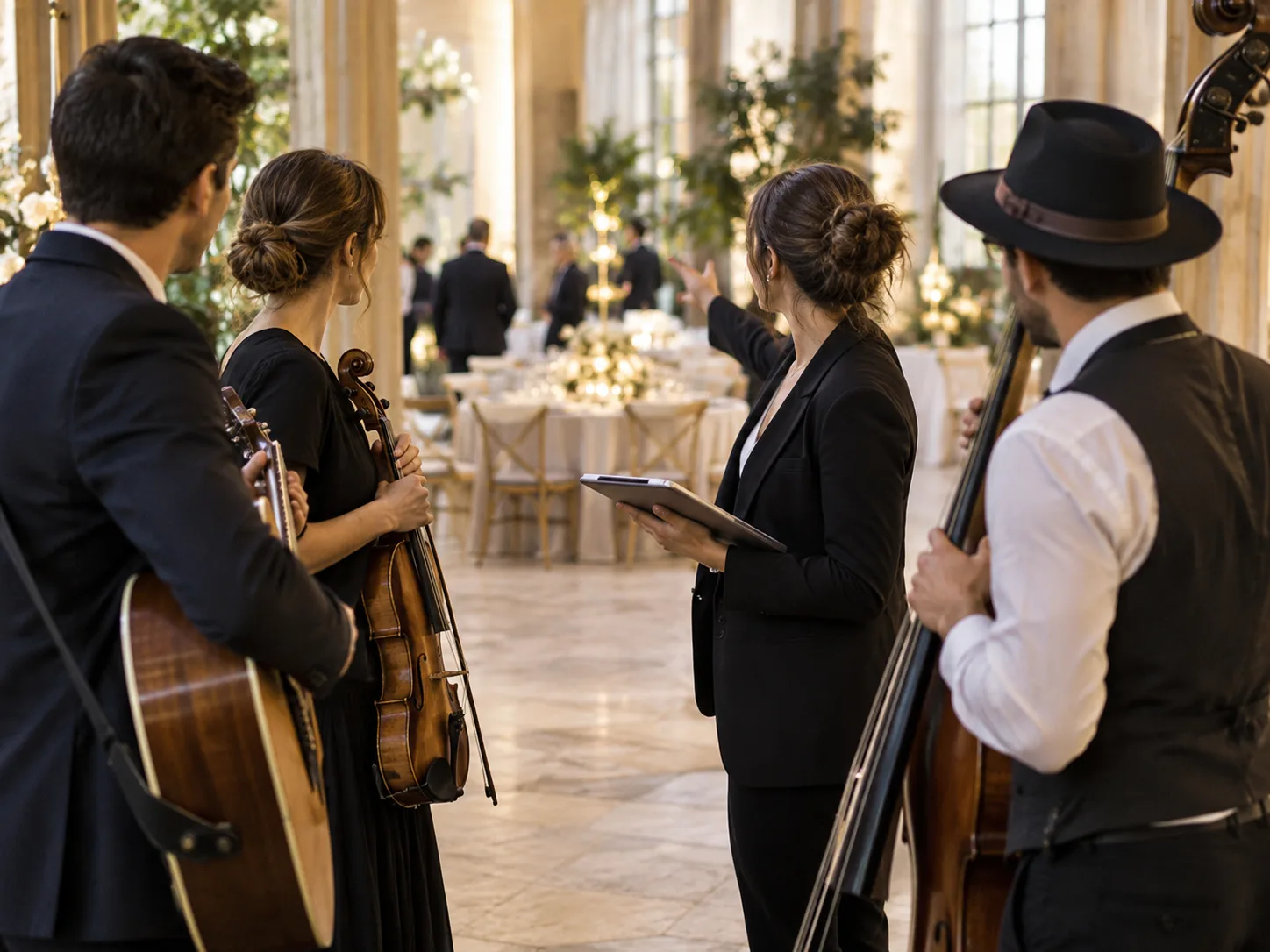
Watch for how band members move as a unit. Do they maintain eye contact with guests? Are formations fluid or awkward? Successful roaming bands rehearse choreography for moving through crowds and between rooms; you should see purposeful motion rather than hesitant shuffling. Note how they position themselves relative to guests—do they create intimacy without overwhelming personal space? This is essential for events like weddings and cocktail receptions.
Audio cues: pitch, timing, and balance
Listen for consistent intonation and timing. A single perfect take is less meaningful than consistent accuracy across a set. Check the lead vocal for pitch steadiness and breath control; in roaming formats, singers must manage variable acoustics and ambient noise. Balance between instruments is also revealing: can the band maintain a clear vocal line when walking, or do guitars and percussion mask the singer? If the band uses wireless mics, ask about range and interference mitigation.
Editing flags and authenticity
Edited videos can hide retakes and overdubs. Look for audio-visual sync issues, abrupt jumps in crowd size or location, and sudden changes in energy that suggest splicing. Authentic uncut footage will show minor imperfections and spontaneous audience reactions. Ask for the original file format or timestamps if authenticity is a concern; bands that are transparent about their footage usually welcome such requests.
Evaluating testimonials, references, and reputational signals
Testimonials can be powerful but must be contextualized. When learning how to evaluate a band without seeing them live, treat testimonials as corroborating evidence, not proof. High-quality references are recent, specific, and linked to similar event types and venue constraints. A glowing quote that says “they were amazing” is less useful than a reference that mentions timing adherence, sound level control, adaptability with a late schedule change, or a complex multi-room layout.
Which references to request and what to ask
Ask for references that reflect the format you need: weddings, corporate receptions, street parades, museum nights, or hospitality activations. Good questions for references include: Did the band arrive with adequate setup time? How did they manage sound checks in a busy venue? Did they interact appropriately with guests? How did they handle unexpected changes like loudspeaker restrictions or last-minute timeline shifts? Ask for contact details and follow up on at least two references — ideally a planner and a venue manager.
Third-party signals and online reputation
Scan venue pages, ticketed event listings, and independent reviews for corroboration. Pay attention to repeated themes: punctuality, noise complaints, or praise for guest engagement are strong signals. Also review social media comments and tagged posts; on-site photos and videos posted by attendees provide unscripted context and can validate the band’s reach and interaction style.
Remote Evaluation Checklist: What to Look For
| Evidence Type | What to Check | Red Flags |
|---|---|---|
| Full performance video | Consistency, audience reaction, movement, uncut length | Heavy editing, abrupt cuts, mismatched audio |
| Audio samples | Pitch, dynamics, balance, clarity in ambient noise | Over-compression, studio fixes, no live mixes |
| References & testimonials | Event similarity, logistics praise, venue feedback | Vague praise, old or unrelated references |
How to Review Repertoire Samples and Arrangements
To know how to evaluate a band without seeing them live, inspect repertoire samples carefully. Roaming bands need flexible arrangements that work at varying volumes and with variable ensembles. Evaluate whether the band can rearrange songs for reduced instrumentation, and whether they have transitional pieces for moving between groups of guests without dead air. Request sample setlists for different durations (15, 30, 45, 60 minutes) and for different moods (ambient, upbeat, singalong), and see if the band shows stylistic range while preserving a coherent sonic identity.
Arrangement quality and adaptability
Listen for arrangements that translate well in close quarters. Stripped-down, acoustic-friendly arrangements often work better in roaming formats than heavily produced studio arrangements. If the band offers medleys, check how they bridge tempos and keys; smooth transitions indicate thoughtful rehearsal. Also ask whether they can re-key songs to suit a vocalist’s range or to adapt to an acoustic set with minimal instruments.
Requests, personalization, and copyrighted material
Clarify the band’s policy on requests and special songs. Can they learn a new song on short notice? Do they charge for bespoke arrangements? Verify their approach to copyrighted material and performance licensing, especially for corporate events or venues with broadcast elements. A professional band will provide a clear policy and, if necessary, documentation for rights clearance.

Create Memorable Events with Live Music That Moves
Discover roaming bands that perform among your guests, create interaction, and elevate weddings, private parties, and corporate events. Explore your options and contact the right band today.
Technical and Logistical Checks to Confirm Remotely
Remote vetting must include a hard look at logistics. A superb band that lacks appropriate equipment or insurance can create last-minute headaches. Use documentation to verify sound system capability, power requirements, wireless reliability, stage footprint needs, transport logistics, and insurance certificates. When learning how to vet a roaming band, require a technical rider and an event-specific logistics sheet that describes exactly how they plan to execute walkaround sets.
Key technical questions
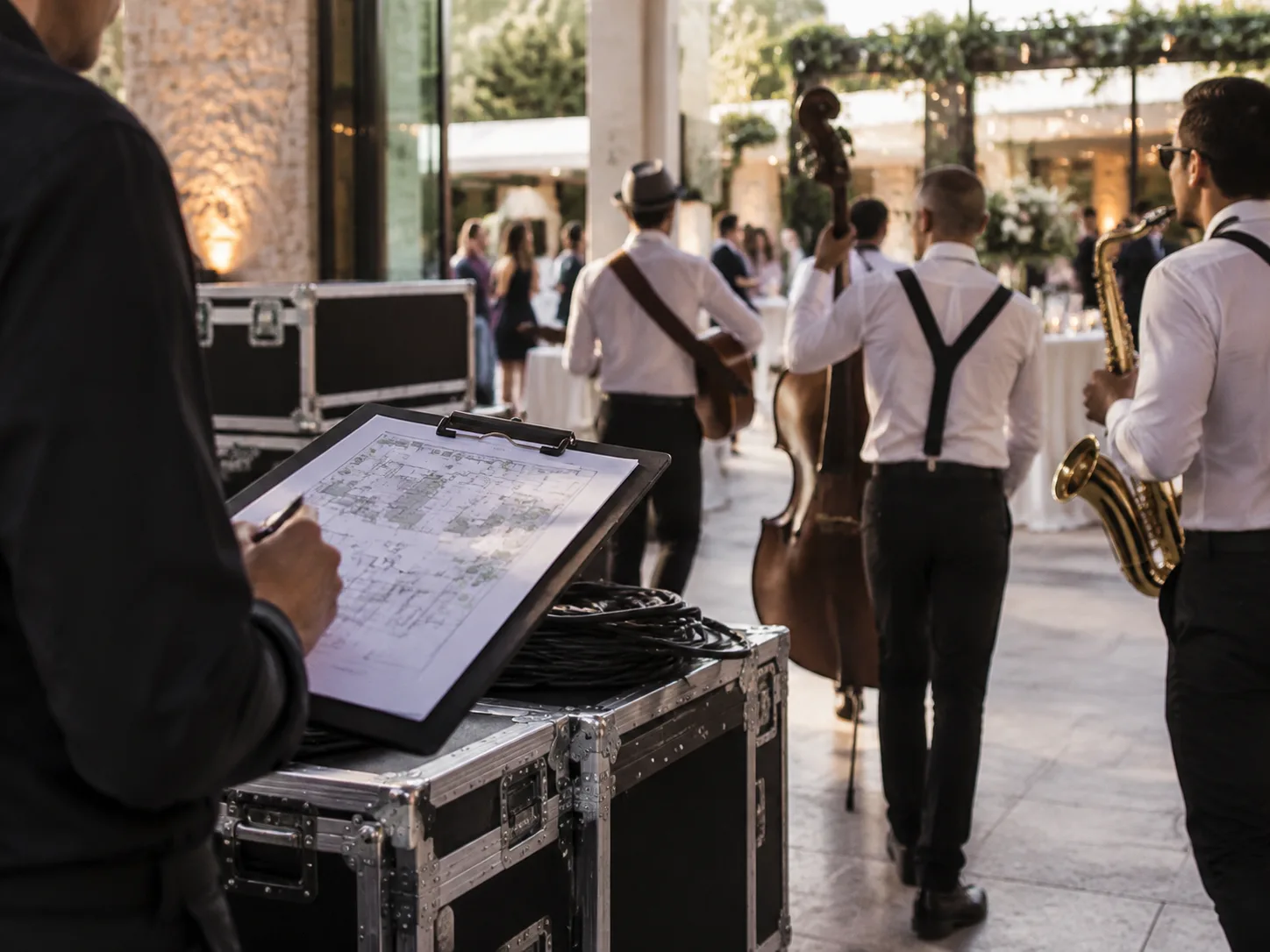
Ask for answers in writing to questions such as: What PA and monitoring system will you bring? How many wireless microphones and what frequency bands do you use? How much setup and teardown time do you need? Can you provide a sketch of typical placement for mobile sets? What are your power draws and cable runs? What backup plans do you have for battery or wireless failures? Professional bands will supply a rider that includes power diagrams, contact numbers, and a fallback plan.
Insurance, permits and noise compliance
Verify general liability insurance and any venue-specific requirements. For outdoor roaming performances, check local permit processes for amplified sound and public assembly. If the venue is noise-sensitive, ask the band about their experience with decibel limits and how they adapt arrangements or amplification to comply. A band’s unwillingness to discuss insurance, permits, or compliance is a significant red flag when you can’t see them live.
Communication, Contracts and Warning Signs
How a band communicates can predict reliability. Clear, prompt, and detailed responses indicate professional practices. In remote vetting, evaluate their responsiveness, willingness to provide documentation, flexibility in problem-solving, and clarity about pricing and cancellation policies. When learning how to vet a roaming band, treat communication quality as an operational KPI: if they fail this test, other issues often follow.
Essential contractual clauses
Request a sample contract and review clauses on performance time, break structure, overtime rates, force majeure, liability, cancellation and refund policy, use of recorded tracks, and requirements for food, water, and rest. Confirm the number of performers guaranteed, substitution policies, and what constitutes acceptable performance. A professional contract reduces ambiguity and sets expectations for both parties.
If you want to check the agreement in more detail, review what should be included in a roaming band contract before confirming the booking.
Common red flags
Watch for vague documentation, evasive answers about references, reluctance to supply a technical rider, inconsistent pricing, or pressure to pay non-refundable deposits without a signed contract. Also be cautious if a band refuses a short remote audition or to share a full-performance recording; transparency is correlated with reliability. If any of these red flags are present, probe further or consider alternate options.
Remote Vetting Plan and Decision Checklist
An efficient remote evaluation uses a consistent process to compare candidates. Here’s a practical plan you can execute in a week before making a hiring decision: Day 1, request full-performance videos and technical rider; Day 2, review recordings and mark timestamps for strengths and concerns; Day 3, request references and repertoire samples; Day 4, contact references and verify logistics with venue; Day 5, conduct a focused video call with the band to ask clarifying questions and discuss custom requests; Day 6, compare candidates against your checklist; Day 7, finalize terms and secure a signed contract.
For a broader pre-booking review, you can also use the 25 questions to ask before booking a roaming band as a reference before comparing candidates or signing an agreement.
Decision checklist
- Uncut video shows consistent quality across songs and positive guest interaction.
- Audio samples display stable intonation and natural dynamics.
- References confirm punctuality, adaptability, and noise awareness.
- Technical rider matches venue power, space, and permit requirements.
- Communication is prompt and contractual terms are explicit.
Weigh these items against your event priorities—musical style, budget, guest expectations, and venue constraints—and then choose the band that best minimizes the highest-risk variables for your event.
Price, negotiation and securing the booking remotely
Negotiation for roaming bands when you can’t see them live is fundamentally transactional but should also preserve relationship-building. Transparent bands present itemized pricing for performance time, travel, additional musicians, special arrangements, sound equipment, and overtime. When you ask how to vet a roaming band from a pricing perspective, request a line-item quote and compare it to the expected value: engagement level, unique arrangements, and logistical complexity.
To understand whether a quote is reasonable, compare the line items against the main factors that influence roaming band cost, including performance time, travel, number of musicians, equipment, and customization.
Negotiation strategies
If you need budget flexibility, consider adjusting time blocks (shorter roaming segments), offering staged performances instead of constant walkarounds, or providing logistical support like dedicated venue staff or power access. You can also request a trial performance or a reduced-cost appearance at a pre-event to validate fit. Always secure a deposit with a clear cancellation and refund policy, and avoid full upfront payments until the contract is signed.
Final confirmation and contingency planning
Before the event, confirm a timeline and a contact tree that lists the band leader, stage manager, venue point person, and your planner. Agree on contingency procedures for bad weather, equipment failures, and schedule slips. A final walk-through—virtual or in-person—with venue staff and the band is a best practice and often reveals issues that paperwork alone misses.
Final Remote Vetting Checklist Before You Book
Remote vetting is about risk management and maximizing reward. A roaming band can transform guest experience with mobility, surprise, and intimacy, but the format increases variables. By using a structured approach—prioritizing authentic full-performance footage, corroborating references, validating technical readiness, and ensuring clear contracts—you can mitigate most risks. Remember that some risk is inherent: allow for margin in schedules and expect minor inconsistencies; what you want to eliminate are systemic issues that would seriously harm the event.
To summarize actionable next steps: request uncut footage, obtain two recent references, secure a tech rider and insurance proof, validate repertoire flexibility, and confirm contractual details. These steps create a defensible decision path and increase buyer confidence even when an in-person audition is impossible.
Remote Vetting Questions Before You Book
? How long should a remote audition video be?
A remote audition video should be long enough to show consistency, movement, sound balance, and guest interaction. For most roaming band formats, 10–20 continuous minutes of unedited footage is a practical minimum.
- Practical example: Ask the band for a single 15-minute clip from a wedding cocktail hour where they move between guests, tables, or different areas of the venue. This helps you evaluate proximity, balance, transitions, and crowd engagement.
- Actionable recommendation: Request the video with timecodes and ask the band to include brief context, such as venue size, number of guests, amplification used, and whether the clip is fully live or edited.
? What verification steps should I use for references?
Reference checks should go beyond reading short reviews. Contact at least two references, ideally one event planner and one venue manager from events similar to yours.
- Practical example: If a planner confirms that the band arrived on time, adapted to a late schedule change, and completed all agreed sets professionally, that is a stronger signal than a generic testimonial saying “they were amazing.”
- Actionable recommendation: Prepare the same short questionnaire for every reference. Ask about punctuality, setup time, sound levels, guest interaction, flexibility, and how the band handled unexpected changes.
? How can I validate technical readiness remotely?
To validate technical readiness, ask for a technical rider, a logistics sheet, and clear answers about sound equipment, microphones, power needs, setup time, backup gear, and venue requirements.
- Practical example: If the band sends a rider showing wireless microphone details, power requirements, setup time, and a basic stage or movement plan, your venue or AV manager can confirm whether the setup is compatible.
- Actionable recommendation: Arrange a short virtual walk-through with the band, planner, and venue contact before signing. This can help identify issues with sound limits, power access, movement routes, or outdoor conditions.
? What contract terms reduce risk when booking remotely?
The most important contract terms are performance time, set duration, breaks, overtime rates, cancellation policy, refund terms, force majeure, substitution rules, sound limits, insurance, and technical requirements.
- Practical example: A substitution clause can reduce risk if one musician becomes unavailable, as long as it states that the replacement must be qualified and match the agreed instrumentation or performance standard.
- Actionable recommendation: Ask your planner, venue manager, or legal advisor to review the contract before you sign, especially if the event has strict sound rules, insurance requirements, outdoor logistics, or international travel.
? How can I compare multiple roaming bands fairly?
The best way to compare multiple roaming bands is to use the same scoring criteria for each candidate. This keeps the decision objective and prevents one polished video from outweighing weaker logistics or unclear communication.
- Practical example: You might assign 30% to uncut performance consistency, 25% to technical readiness, 20% to references, 15% to communication, and 10% to price.
- Actionable recommendation: Use a simple spreadsheet and add evidence for each score, such as video timestamps, reference comments, rider details, response times, and contract clarity.