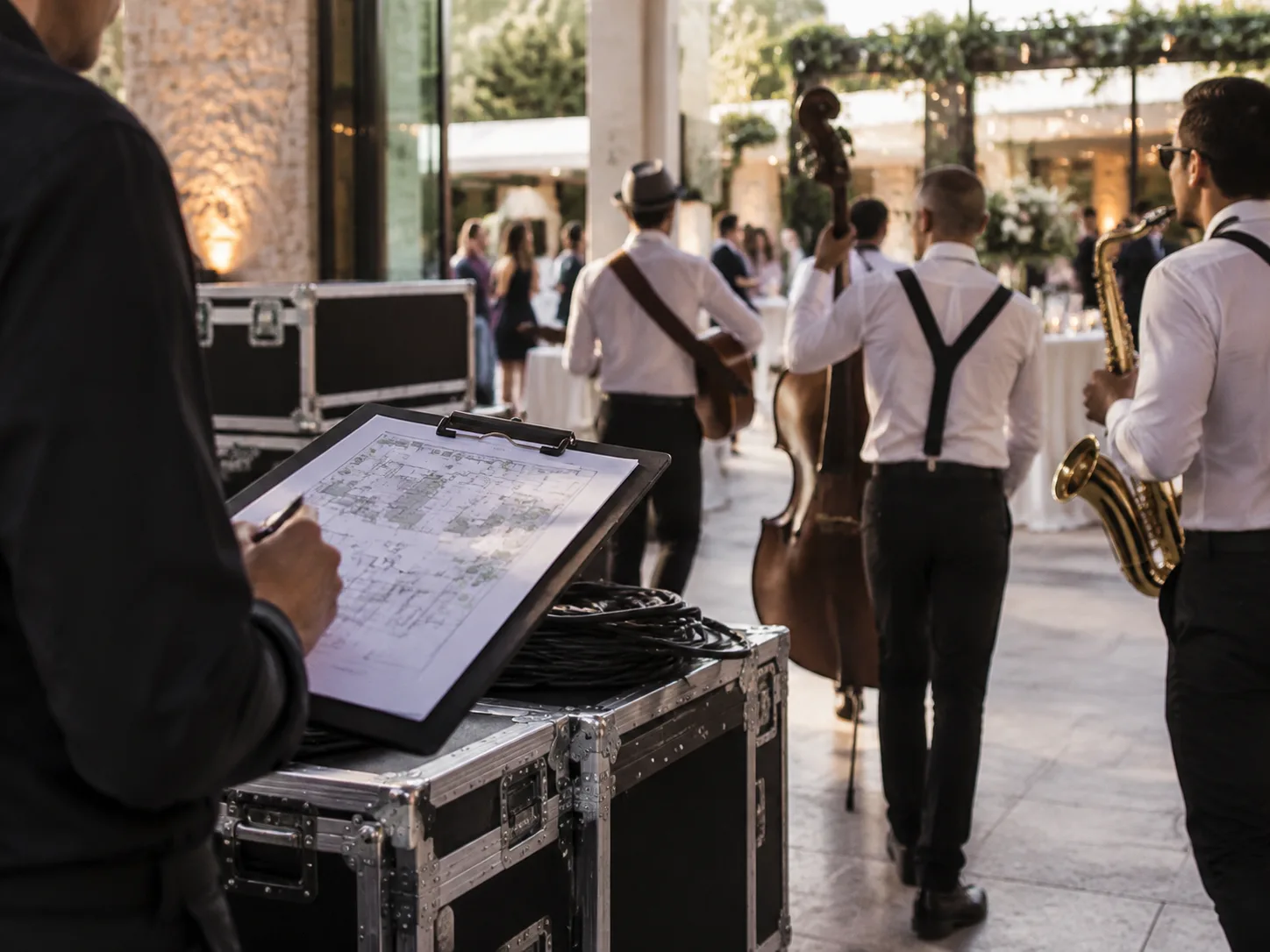
Booking a roaming band requires asking about their mobility, technical needs (battery/PA), repertoire flexibility, and total costs, including travel. Most professional acts recommend a 60–90 minute load-in window and provide a detailed contract covering illness contingencies and liability insurance.
In this guide, you will find 25 questions to ask before booking a roaming band to evaluate performers, manage venue logistics, and avoid common pitfalls like hidden fees or sound restrictions.
Start here: credentials, experience, and format
1. How long has the band been performing as a roaming act?
Ask for a brief history of the ensemble, focusing on their experience in strolling formats. Longevity in this niche indicates refined crowd interaction skills and a repertoire that adapts to movement. Look for bands that describe repeat bookings at weddings and corporate receptions rather than just stationary stage gigs.
2. Can you provide references or event-specific recordings?
Request unedited, audience-level clips from actual roaming performances. Audio and video shot “in the crowd” reveal how the band navigates guests and manages sound bleed. For a deeper dive into budgeting for these services, consult our roaming band cost guide in 2026.
Why format matters
3. What roaming formats do you offer (parade, strolling acoustic, pop-up sets, blended stage/roam)?
Different formats demand different resources and techniques. A walking parade through a garden uses different arrangements, physical stamina expectations, and safety protocols than a series of stationary pop-up sets in a ballroom. Confirm the band’s experience in the specific roaming style you want; that informs rhythm, transitions, and length of sets.
Repertoire, arrangement, and guest experience
4. What is your typical setlist, and how flexible is it?
Request a representative repertoire list and ask how much personalization is included. Good roaming acts present adaptable arrangements to suit guest demographics, event tone, and special moments like cake cutting or speeches. Confirm whether the band will accept a do-not-play list and whether they can learn a requested song within your timeline.
5. How do you manage song length and transitions during roaming sets?
Roaming bands must anticipate variable crowd flow and interruptible listening. Ask about standard set durations, silent passage handling, and whether they use medleys or short-form arrangements to maximize variety without overstaying in one area. This is part of any practical booking of a roaming band checklist: predictable timing and smooth transitions mitigate guest fatigue and logistical confusion.
Interaction levels and staging choices
6. What is your approach to interacting with guests?
Determine whether the group performs as an unobtrusive background ensemble, an interactive strolling band that encourages dancing, or a hybrid that alternates between passive and active engagement. The band should match your event’s desired social dynamics and the venue’s tolerance for noise and crowd movement.
Technical needs: sound, power, and mobility
7. What amplification, monitoring, and battery solutions do you use?
Roaming bands range from purely acoustic to fully wireless amplified setups. Ask for a technical rider specifying battery life for wireless systems and whether they require mixing support from the venue. This is critical for managing sound levels in large spaces.
8. What are your power and access requirements?
Confirm if the band needs on-site power or brings portable generators. If your venue has narrow corridors or multiple levels, the band needs advance notice to adapt their mobility. Be sure to factor in logistical expenses by reviewing the roaming band travel fees guide, which covers transportation and access variables.
Noise control and venue compatibility
9. How do you handle noise restrictions or strict venue policies?
Experienced roaming bands provide compliant set levels and can supply decibel targets for coordination with venues. Ask if they have performed at sites with curfews or strict sound ordinances and how they adjust set plans to conform to such restrictions without compromising the guest experience.
Logistics, timing, and event flow
10. What is your arrival, load-in, and warm-up timeline?
Clarify exact arrival times, load-in procedures, on-site staging locations, and warm-up needs. Roaming acts often need extra time to scout the route, mark safe stopping points, and coordinate with event staff. A strong answer includes a clear timeline and contingency plans if earlier event components run late.
11. How do you coordinate with event suppliers and the MC?
Because roaming bands move through the event, they must integrate with catering, audiovisual teams, and the event MC. Ask whether they appoint a point person for coordination, how they receive timing cues, and whether they can follow a formal run sheet or a flexible cue-driven flow.
Set lengths, breaks, and staffing
12. What are your standard set lengths, break patterns, and minimum staffing levels?
Confirm how many musicians perform simultaneously during roaming segments, typical set durations, and how breaks are handled (e.g., staggered, short downtime in a designated staging area). Ensure staffing numbers meet your desired sound density and coverage for large or dispersed guest lists.
Contracts, pricing, and payment
13. What is your fee structure and what’s included?
Request an itemized quote that covers performance time, professional liability insurance, and any equipment hire. Understanding the full financial commitment upfront prevents last-minute surprises. A clear breakdown should distinguish between the base performance fee and operational overheads.
14. What is your cancellation and contingency policy?
Confirm the deposit amount and the “force majeure” conditions. A professional contract should outline protocols for member illness or travel disruptions. Ensure the agreement includes a failover plan, such as providing replacement musicians of equal caliber or a proportional refund if the performance cannot proceed.
Insurance and permits
15. Do you carry liability insurance and any required permits?
Verify coverage limits and whether the band can provide a certificate of insurance naming the venue as additional insured if required. For public routes or city streets, ask if the band or the planner will secure performance permits; assigning responsibility ahead prevents last-minute legal issues.
Risk management and contingencies
16. What is your contingency plan for member illness, equipment failure, or travel disruption?
Ask about backup personnel, replacement instruments, spare batteries, and a failover PA. A professional roaming band has protocols for common problems and will communicate how they will maintain performance continuity or offer fair refunds if continuation is impossible.
17. How do you handle adverse weather for outdoor roaming?
Outdoor roaming needs specific plans: waterproofing instruments, relocating to covered areas, or switching to acoustic-only sets. Confirm exact thresholds for cancellation versus adaptation, and whether refunds or rescheduling policies apply in those scenarios.
Audience safety, accessibility, and inclusivity
18. How do you ensure guest safety during roaming sets?
Discuss movement protocols to avoid collisions, how musicians manage crowd density, and whether they use signage or liaison staff to guide traffic. For events with elderly guests or mobility devices, confirm that the band can modify routes and pacing to maintain comfort and safety.
19. Can you accommodate guests with sensory sensitivities or special needs?
Some attendees may require lower-volume zones or quieter interactions. Good bands offer options like unplugged segments, seating areas for sensitive listeners, or advance coordination with accessibility staff to ensure inclusive experiences.
Branding, attire, and presentation
20. What is your standard wardrobe and can you match dress codes or event themes?
Roaming bands often have signature looks—period costumes, branded polos, or formal wear. Ask whether they can adapt attire to suit black-tie weddings, themed corporate activations, or casual backyard parties. Visual fit is as important as musical fit for immersive events.
21. Do you provide branded materials or promotional assets?
If you want coordinated signage or program notes, check whether the band supplies logos, short bios, and song lists for event materials. This is useful for event programs and helps MCs introduce the group correctly.
Measurement and success criteria
22. How do you measure success and collect feedback?
Ask how the band evaluates success—audience engagement metrics (dancing, singalongs), client feedback processes, or post-event reporting. Establish whether they will provide a brief post-event summary or accept client feedback for continuous improvement. Adding these items to your booking a roaming band checklist helps future procurement.
23. Can you provide case studies of measurable outcomes?
Request short case studies that show quantifiable results, such as increased guest movement through a reception space, higher social media engagement with branded activations, or client satisfaction scores. These examples demonstrate the band’s ability to meet event objectives beyond just playing music.
Final practical questions before signing
24. Who will be our point of contact on the day, and how do you handle last-minute changes?
Confirm a single on-site contact, backup contacts, and acceptable communication channels (walkie-talkie, phone, event platform). Clarify the window for last-minute requests and whether the band charges for changes within 24–48 hours of the event.
25. Are there any venue or client responsibilities we must meet?
Request a short checklist from the band that outlines what the client or venue must provide: staging areas, access windows, security if roaming in public spaces, power access, and coordination with other suppliers. This practical client-side checklist prevents last-minute gaps and aligns expectations before you finalize the agreement.

Create Memorable Events with Live Music That Moves
Discover roaming bands that perform among your guests, create interaction, and elevate weddings, private parties, and corporate events. Explore your options and contact the right band today.
Booking a roaming band checklist
The table below condenses core items to evaluate during selection and negotiation; use it as a middle-of-process reference when comparing proposals.
| Category | Key Questions | Practical Evidence |
|---|---|---|
| Experience & Format | Years roaming, sample videos, format types | Unedited clips, client references |
| Technical Needs | Power, PA, battery life, site map | Technical rider, equipment list |
| Commercial Terms | Fee breakdown, deposit, cancellation | Detailed quote, written contract |
Practical scenarios and examples
To make these questions actionable, consider three common scenarios: a garden wedding, a corporate cocktail lounge, and a festival circulation zone. Each demands different answers. For a garden wedding you may prioritize quiet acoustic sets and accessibility; for a corporate lounge you need brand-aligned attire and timing around speeches; for a festival you want amplified roaming and strong contingency plans for weather and crowd control. Comparing band responses against the scenario-specific demands reveals fit beyond general promises.
Example: if your venue is a historic house with narrow corridors, ask specifically about instrument sizes and whether the band can perform with compact electric setups. A band that has done similar sites will propose route maps and a plan to avoid bottlenecks, while an inexperienced group may not account for restricted access.
Comparing multiple bands: scoring and selection
Use a simple scoring model to compare proposals: categories like experience (0–10), technical readiness (0–10), repertoire fit (0–10), logistical clarity (0–10), and commercial transparency (0–10). Weight categories according to event priorities and produce a consolidated score. This objective method converts subjective impressions into measurable comparisons and becomes a part of your booking a roaming band checklist when evaluating finalists.
Red flags and warning signs
Identifying warning signs early can save your event from serious logistical or legal complications.
-
Lack of Transparency: Reluctance to share unedited live videos or verified client references.
-
Legal Gaps: Refusal to provide a written contract, liability insurance, or clear refund policies.
-
Inconsistency: Contradictory answers between verbal promises and the final written agreement.
The absence of contingency plans for member illness or equipment failure is enough reason to seek an alternative provider.
Negotiation tips and contract clauses to request
Negotiate clear milestones: deposit percentage, final payment due date, and a defined performance schedule with start and end times. Request a simple force majeure clause tailored to your event and a staged refund policy that scales with proximity to the event date. Add a clause that requires the band to provide a backup contact and to attempt replacement musicians before declaring cancellation due to illness. Finally, include a short rider specifying access routes, set locations, and staging areas to be agreed upon in venue walkthroughs.
Example clause language
Include statements like: “Band will arrive no later than X minutes before first scheduled set and will perform Y sets of Z minutes each; in the event of illness, band will provide qualified replacement musicians equal in number and instrumentation, or refund fees proportionally.” Having concise, operational language avoids interpretive disputes later.
Create Memorable Events with Live Music That Moves
Discover roaming bands that perform among your guests, create interaction, and elevate weddings, private parties, and corporate events. Explore your options and contact the right band today.
Final Selection and Implementation Strategy
To finalize your booking, weigh each band’s technical readiness against your event objectives. Before submitting a deposit, ensure all logistics and insurance certificates are confirmed.
-
The Run Sheet: Create a document listing set times, mobile contact numbers, and power locations.
-
Vendor Alignment: Share the finalized schedule with the venue manager and caterer at least 24 hours in advance.
Pro-Tip: Conduct a brief walkthrough (physical or virtual) to confirm transition points. While roaming bands offer high-impact entertainment, a structured approach ensures your musical choice remains a highlight rather than a logistical burden.
Common Practical Questions
? How much time should I allow for load-in?
- Actionable recommendation: build the agreed load-in time into your run sheet and require written confirmation from the band and venue 48 hours before the event so everyone arrives with the same expectations.
? What are typical additional costs beyond the quoted fee?
- Actionable recommendation: request a fully itemized quote that lists potential surcharges and cap any variable fees in your contract to avoid surprises.
? How to evaluate a band’s contingency planning?
- Example: when a guitarist fell ill two days before an event, a well-prepared band supplied a qualified replacement and provided a short video rehearsal clip demonstrating the substitute’s fit, allowing the client to approve.
- Actionable recommendation: include a contractual clause requiring that the band either supply replacement musicians of equivalent skill or refund proportionally if no replacement is available.
? What metrics should I track to judge performance impact?
- Example: a product launch reported a 30% uplift in social posts during the band’s roaming sets, correlating with increased booth visits.
- Actionable recommendation: define 2–3 KPIs with the band before the event and agree on how to collect evidence—short video clips, guest counts, or social analytics—so you can assess ROI post-event.
? How far in advance should I confirm repertoire and logistics?
- Actionable recommendation: set firm internal deadlines for delivery of the final run sheet and repertoire no later than 14 days before the event, and include a clause that stipulates additional fees for changes after that date.